
Paver Base Calculator: How Much Paver Base Do I Need?
Planning a patio, walkway, or driveway and wondering, “How much paver base do I need?” Our free paver base calculator makes it easy to estimate cubic yards, convert to tons, or calculate the number of retail bags needed for your project. Simply enter your dimensions to get instant, accurate results including a 20% compaction allowance.
A paver base calculator converts your patio, walkway, or driveway dimensions into the exact volume of crushed stone or gravel to order. Just as you would use our primary Gravel Calculator to estimate gravel roads or pathways, calculating base materials accurately prevents ordering delays, saves money, and ensures your hardscape foundation will not shift or sag over time.
How Much Paver Base Do I Need?
A 10-by-12-foot patio needs 1.78 cubic yards of paver base at a compacted depth of 4 inches. That equals 2.4 tons, or 96 bags of the standard 0.5 cubic foot bag size.
Paver Base & Sand Calculator
Enter dimensions below to calculate yards, bags, weight, and cost.
6″ Driveway
8″ Weak Soil
Estimated Volume Results (Inc. 20% Compaction)
4,800 lbs
0.50 tons (10 cu ft)
$0.00
Work out any size in four steps:
- Calculate Square Footage: Multiply length in feet by width in feet to get your area in square feet.
- Multiply by Depth: Multiply that area by your base depth in inches.
- Divide by 324: Divide the result by 324 to get the cubic yards of compacted base.
- Add Compaction Allowance: Multiply by 1.20 to cover the 20% compaction rate. This is the final volume of loose material you should order.
Some calculators measure everything in inches and divide by 46,656 instead. Both routes give the same answer. For instance, a 10-by-10-foot patio at 4 inches works out to 1.235 cubic yards either way, so a number you check against a second site should match.
The reference table below shows the calculated requirements for common patio sizes, already including the 20 percent compaction allowance:
| Patio Size | Total Area | Paver Base (at 4″ Depth) | Est. Weight (Tons) | 0.5 cu ft Bags |
|---|---|---|---|---|
| 8 × 10 ft | 80 sq ft | 1.19 cu yd | 1.60 tons | 64 bags |
| 10 × 10 ft | 100 sq ft | 1.48 cu yd | 2.00 tons | 80 bags |
| 10 × 12 ft | 120 sq ft | 1.78 cu yd | 2.40 tons | 96 bags |
| 12 × 12 ft | 144 sq ft | 2.13 cu yd | 2.88 tons | 115 bags |
| 12 × 16 ft | 192 sq ft | 2.84 cu yd | 3.84 tons | 154 bags |
| 14 × 20 ft | 280 sq ft | 4.15 cu yd | 5.60 tons | 224 bags |
| 16 × 20 ft | 320 sq ft | 4.74 cu yd | 6.40 tons | 256 bags |
| 20 × 20 ft | 400 sq ft | 5.93 cu yd | 8.00 tons | 320 bags |
How Deep Should a Paver Base Be?
Patios and walkways need 4 inches of compacted paver base. Driveways need 6 inches. Both figures apply to well-drained soil.
Those depths come from CMHA Tech Note PAV-TEC-002, the industry construction standard for interlocking concrete pavements. The standard sets 4 inches as the minimum base thickness after compaction for sidewalks, patios, and pedestrian areas over well-drained soils. Residential driveways on well-drained soils need at least 6 inches.
| Project Type | Compacted Base Depth | Application Guidelines |
|---|---|---|
| Patio, sidewalk, pedestrian area | 4 inches minimum | Soil drains well |
| Walkway | 4 inches | Soil drains well |
| Residential driveway | 6 inches minimum | Soil drains well |
| Any of the above in cold climates or wet, weak soil | Thicker than the minimum | Add 2 inches as a working figure |
| Pool deck | 4 to 6 inches | Drainage matters most here |
Two critical details in that construction standard change your order, though most sources drop them:
- After Compaction: Four inches is the finished thickness once you have run the plate compactor. Order 4 inches of loose material, and it will compress down to about 3.3 inches.
- Well-Drained Soils: Clay holds water and saturated ground stays soft. Cold regions push frost into the base. Colder climates and continually wet or weak soils require thicker bases.
That qualifier explains a conflict you will hit if you check two sources. Lowe’s states the paver base for a patio or walkway should be 6 inches deep when compacted, while most calculators default to 4. Both are right: 4 inches is the compacted minimum on good soil, while 6 inches is the sensible choice on clay or in freeze-prone regions.
Going deeper costs real work. Moving from 4 inches to 6 inches on a 200-square-foot patio adds 1.48 cubic yards, which is about 2 more tons to shift by hand.
Does This Calculator Already Include Compaction?
Yes. The calculations on this page already include a 20 percent compaction allowance. Do not add extra on top. Loose crushed stone shrinks when you compact it. Order exactly enough to fill a 6-inch trench, and you will finish with roughly 5 inches of base once the compactor has done its work.
The compaction allowance is not the same for every material:
| Compaction Factor | Material Type |
|---|---|
| 1.15 (15% increase) | Clean rounded gravel |
| 1.20 (20% increase) | Crushed stone and crusher run |
| 1.25 (25% increase) | Fine crushed stone and stone dust |
These compaction factors suit crusher run and #57 stone. The difference is the material, not a difference of opinion. Angular stone with a lot of fine particles packs tighter than clean rounded stone, so it shrinks more under pressure.
Compacted bases for pedestrian areas and residential driveways should reach a minimum 98 percent of standard Proctor density. Contractors verify this with a nuclear density gauge. For DIY installations, you can use these field tests:
- Make 3 to 4 passes with the plate compactor until extra passes stop lowering the surface.
- Walk across the base. Your boots should leave no footprints.
- Drop a brick from waist height. It should bounce, not dent the surface.
Cubic Yards, Tons, or Bags: What Do You Actually Order?
Three units describe one volume. Aggregate yards quote in tons, calculators output in cubic yards, and home improvement stores sell paver base in 0.5 cubic foot bags. You can convert cubic yards to tons by multiplying by the density of your material:
| Material Type | Tons per Cubic Yard |
|---|---|
| Bank-run gravel | 1.25 tons |
| Recycled concrete | 1.30 tons |
| Crushed limestone | 1.35 tons |
| Crusher run and quarry process | 1.35 tons |
| Crushed granite | 1.40 tons |
Individual products vary further. For example, some suppliers list crushed concrete paver base at 3/8-inch minus at 2,410 pounds per cubic yard (which is 1.21 tons per cubic yard). A 200-square-foot patio at 4 inches compacted depth comes to 2.47 cubic yards before compaction. Priced at 1.21 tons per cubic yard, that is 2.99 tons, whereas at 1.5 tons per cubic yard it is 3.71 tons. Ask your supplier for the density of the exact product you are buying.
For bags, one 0.5 cubic foot bag of bagged paver base covers 6.0 square feet at 1 inch deep. Coverage drops to 3.0 square feet at 2 inches, and 1.5 square feet at 4 inches. One cubic yard equals 54 bags. A standard pallet holds 64 bags (32 cubic feet).
Bulk crusher run and #57 stone run $35 to $65 per cubic yard. Bagged paver base runs $4 to $8 per 50-pound bag. The deciding number is often the delivery fee, not the price per yard:
| Project Size & Depth | Bags Needed | Bagged Cost ($4/bag) | Bulk Cost ($45/yd + $75 delivery) |
|---|---|---|---|
| 20 sq ft at 4″ | 16 bags | $64 | $120 |
| 40 sq ft at 4″ | 32 bags | $128 | $120 |
| 100 sq ft at 4″ | 80 bags | $320 | $142 |
| 144 sq ft at 6″ | 173 bags | $691 | $219 |
At that delivery fee, the break-even point lands around 30 to 40 square feet at 4 inches. Above 50 square feet, bulk wins by a wide margin. Below that line, bags are the better buy despite costing far more per cubic foot. Paying a delivery fee to receive half a yard makes no sense, and bags fit easily in a car trunk. Small repair jobs and short garden paths belong in bags.
How Many Truck Loads Is That?
A half-ton pickup carries about 1 cubic yard of gravel, and a three-quarter ton pickup handles 1 to 1.5 cubic yards. Treat these as working figures and check your own truck’s payload sticker.
| Paver Base Needed | Est. Weight | Half-Ton Pickup Loads | Wheelbarrow Loads |
|---|---|---|---|
| 1.48 cu yd (100 sq ft at 4″) | 2.0 tons | 2 loads | 13 loads |
| 2.96 cu yd (200 sq ft at 4″) | 4.0 tons | 3 loads | 27 loads |
| 4.44 cu yd (300 sq ft at 4″) | 6.0 tons | 5 loads | 40 loads |
Fenced back yards create the real transport problem. If you have no dump truck access to the back yard, you may have to dump the material on a tarp out front. Moving 3.5 tons of aggregate by wheelbarrow can take 3 to 4 hours. Measure your gate before you order. Ask whether the yard packs paver base in cubic-yard sacks, which a small forklift can set close to the work area.
How Deep Do You Dig for a Paver Patio?
Excavate 7 3/8 inches below finished grade for a standard patio. Driveways need 9 3/8 inches. Excavation depth is not the same as base depth. Add the three component layers together:
- Patio: 4 inches of paver base + 1 inch of bedding sand + 2 3/8-inch paver = 7 3/8 inches.
- Driveway: 6 inches of paver base + 1 inch of bedding sand + 2 3/8-inch paver = 9 3/8 inches.
Pedestrian areas and residential driveways take pavers 2 3/8 inches thick. Streets and industrial pavements use units at least 3 1/8 inches thick. Check your paver’s actual thickness before you dig, because thicker units push the depth requirement up.
Digging only the base depth means the finished patio will sit about 3 3/8 inches above the surrounding lawn, creating issues for door thresholds, existing slabs, and lawnmowers.
What Kind of Gravel Do You Use Under Pavers?
Use crusher run (also sold as dense-graded aggregate) or #57 crushed stone. Both are angular. Angular stone locks together under a compactor and holds its shape, unlike pea gravel and river rock, which roll like ball bearings.
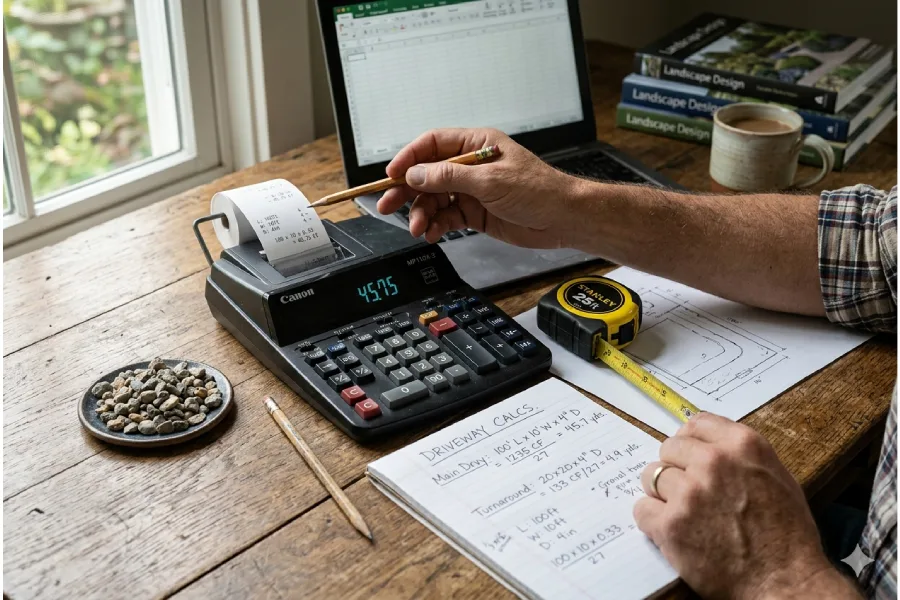
This product carries different names by region: dense-graded aggregate, DGA, crusher run, quarry process, QP, 2A modified, Class II road base, ABC gravel, 3/4-inch minus, and 5/8-inch minus. Ask for dense-graded aggregate for a paver base, and most suppliers will know exactly what you want.
Recycled concrete works within limits. Vehicle areas should take no more than 50 percent recycled concrete aggregate blended with quarried aggregate, while pedestrian projects can use up to 100 percent recycled concrete.
How Much Paver Sand Do You Need?
A 100-square-foot patio needs 0.31 cubic yards of bedding sand at 1 inch deep. That is 0.42 tons.
Bedding sand under concrete pavers should conform to ASTM C33 (concrete sand). Ask for washed concrete sand by name. Do not use masonry sand, limestone screenings, or stone dust for bedding.
Bedding sand does not require a compaction allowance. Order the exact screeded volume of sand, with no extra compaction factor added.
| Patio Area | Bedding Sand (at 1″ Depth) | Est. Weight (Tons) |
|---|---|---|
| 100 sq ft | 0.31 cu yd | 0.42 tons |
| 200 sq ft | 0.62 cu yd | 0.83 tons |
| 400 sq ft | 1.23 cu yd | 1.67 tons |
Joint sand is swept between the pavers on a later day. That is a separate product and is not counted here.
How Much Extra Paver Base Should You Order?
Order 10 percent more than the calculated volume. That covers spillage, low spots in the subgrade, and material lost past the edges. Then, account for the over-dig: excavate 6 inches past the paver edge on every unsupported side. Edge pavers with no base beneath them tip outward under load. That extra strip is not a rounding error:
| Patio Dimensions | Footprint with 6″ Over-Dig | Paver Base (at 4″ Depth) | Volume Increase |
|---|---|---|---|
| 10 × 10 ft | 100 → 121 sq ft | 1.48 → 1.79 cu yd | +21% |
| 10 × 12 ft | 120 → 143 sq ft | 1.78 → 2.12 cu yd | +19% |
| 12 × 16 ft | 192 → 221 sq ft | 2.84 → 3.27 cu yd | +15% |
Plan your compaction passes around your equipment. The standard calls for spreading and compacting the base in 4 to 6 inch lifts with a 7,000 pound-force reversible plate compactor. Lighter rental compactors (in the 5,000 pound-force range) require thinner 2-inch lifts, compacted one at a time, rather than one deep pour.
What Does Paver Base Cost?
Bulk paver base costs $35 to $65 per cubic yard, while bagged base costs $4 to $8 per 50-pound, 0.5 cubic foot bag.
| Purchase Form | Typical US Price |
|---|---|
| Bulk crusher run or #57 (per cubic yard) | $35 to $65 |
| Bagged paver base (50 lb / 0.5 cu ft) | $4 to $8 |
It is best to buy aggregate from an aggregate supplier, not the company selling you pavers, where markups can be up to 10 times higher. Always ask two questions when you call the yard: the delivery fee, and the minimum order. Those numbers determine whether bulk or bags is cheaper for a small job.
Mistakes That Cost You a Second Delivery
- Ordering Compacted Volume: A 4-inch finished base needs about 4.8 inches of loose material. Skip the compaction allowance and you land 20% short.
- Measuring the Patio Instead of Excavation: The 6-inch over-dig on each side adds 15% to 21% to a typical patio order.
- Buying Bagged for a Large Job: A 144-square-foot patio at 6 inches deep needs 173 bags (~$691) compared to about $219 for bulk delivery.
- Asking the Yard for “Gravel”: You may be handed pea gravel which will not compact. Ask for dense-graded aggregate or #57 crushed stone.
- Adding Compaction Twice: The calculator on this page already includes compaction. Adding another 20% by hand creates a surplus pile you have to haul away.
Paver Base Calculator FAQ
How many bags of paver base equal one cubic yard?
One cubic yard equals 54 bags of paver base at the standard 0.5 cubic foot bag size. A 0.5 cubic foot bag covers 1.5 square feet at 4 inches deep. Pallets hold 64 bags.
Is the 4-inch paver base measured before or after compaction?
Four inches is the compacted thickness, measured after tamping. Ordering four inches of loose material leaves roughly 3.3 inches once compacted. Order 20 percent extra volume so the finished base reaches four inches. CMHA specifies four inches minimum for patios.
Why do two paver base calculators give different tonnage for the same patio?
Tonnage depends on material density, which varies by rock type. Bank-run gravel weighs 1.25 tons per cubic yard, crushed limestone 1.35, crushed granite 1.40. Published compaction factors also differ between 15 and 20 percent. The same patio can span a 24 percent tonnage range.
How deep do you dig for a paver patio?
Excavate 7 3/8 inches below finished grade for a standard patio: 4 inches of compacted base, 1 inch of bedding sand, and a 2 3/8-inch paver. Driveways need 9 3/8 inches. Digging only the base depth leaves the finished patio standing above surrounding grade.
Is it cheaper to buy paver base in bags or in bulk?
Bulk is cheaper above roughly 40 square feet at 4 inches deep. Bulk crusher run costs $35 to $65 per cubic yard; bagged base costs $4 to $8 per 0.5 cubic foot bag. Below 40 square feet, delivery fees make bags cheaper.
Why does gravel need a compaction allowance but bedding sand does not?
Base gravel gets compacted with a plate compactor, losing about 20 percent of its loose volume. Bedding sand is screeded to an uncompacted 1-inch thickness and left undisturbed until pavers are laid. Order the exact screeded volume of sand, with no allowance added.
Related Material Calculators
Planning a larger landscaping or construction project? These calculators work alongside the paver base calculator to help you estimate all the materials you need:
- Rock Calculator — calculate decorative landscape rock volume
- Mulch Calculator — estimate landscape mulch volume for garden beds