
Paver Base Calculator
Gravel Calculator helps homeowners and DIY installers order the right amount of paver base in cubic yards, tons, and bags, from patio size and base depth. Every result shows its density and waste assumptions, and you can enter your quarry’s ticket weight before you order. It isn’t built for engineered pavement or failing subgrades.
Enter the length and width of your patio, walkway, or driveway, choose a base depth, and pick your stone. The calculator returns base volume in cubic yards, tons, and bags, plus the bedding sand for the 1-inch layer. Each result lists the density, compaction allowance, and waste it used.
Paver Base & Sand Calculator
Enter dimensions below to calculate yards, bags, weight, and cost.
6″ Driveway
8″ Weak Soil
Estimated Volume Results (Inc. 20% Compaction)
4,800 lbs
0.50 tons (10 cu ft)
$0.00
How much paver base do I need?
For a standard paver patio, order 4 inches of compacted crushed stone base plus 1 inch of bedding sand, then add 20 percent for compaction and 5 percent for waste.
To do the math yourself:
- Multiply length by width: Calculate your area in square feet.
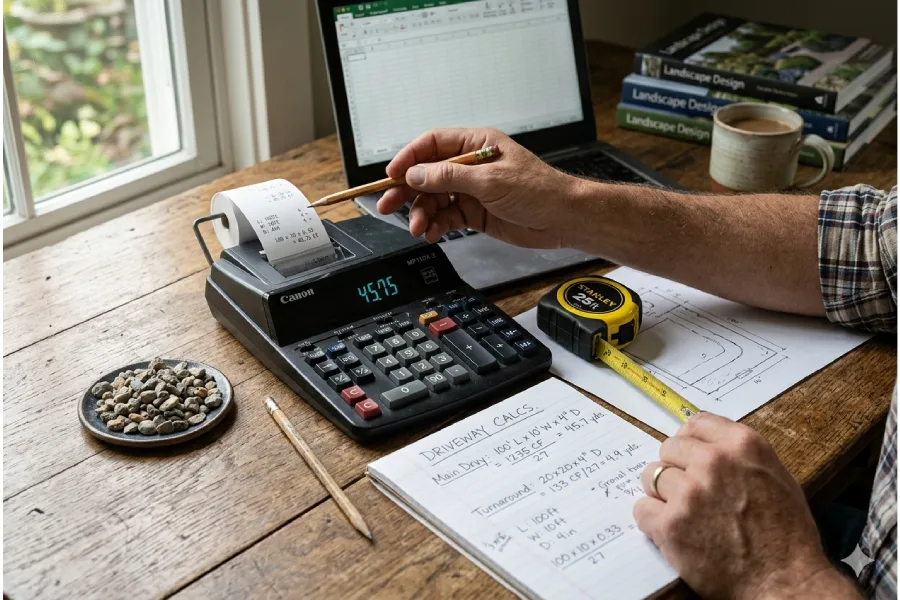
- Multiply the area by base depth in feet: (Inches divided by 12). Four inches is one-third of a foot, so 192 square feet at 4 inches is 64 cubic feet.
- Divide cubic feet by 27: This gives the volume in cubic yards.
- Add compaction and waste: Multiply by 1.20 for compaction and by 1.05 for waste.
- Multiply by stone density: Use your stone’s density in tons per cubic yard (#57 stone is 1.40).
For an irregular shape, split it into rectangles, calculate each one, and add the results.
How deep should paver base be?
Use 4 inches of compacted base for a pedestrian patio on stable soil, and go deeper for freeze-thaw climates, soft soil, or driveways. Use this table as the starting point:
| Use | Compacted Base | Choose This When |
|---|---|---|
| Walkway or pedestrian patio | 4 inches | Stable, well-drained soil |
| Patio in a freeze-thaw climate or soft soil | 6 inches | The ground heaves or stays wet |
| Driveway for cars only | 8 inches | Vehicle load on the surface |
| Driveway for trucks, heavy clay, or freeze-thaw | 10 to 12 inches | The subgrade check in this guide shows clay or wet soil |
| Deeper than 12 inches | Ask a licensed engineer | Severe clay or a failed subgrade |
Decorative patio gravel is usually 2 to 3 inches. That’s a surface layer, not paver base, so don’t use it under pavers.
What stone goes under pavers?
Use angular crushed stone, such as #57 or ¾-inch minus crushed limestone, because its edges lock together under compaction.
| Material | Density (tons per cu yd) | Under Pavers? |
|---|---|---|
| #57 crushed stone (¾-inch) | 1.40 | Yes. The most common choice. |
| ¾-inch crushed stone | 1.42 | Yes |
| Crushed limestone, ¾-inch minus | 1.40 | Yes. The fines help it compact. |
| Crusher run (dense-graded aggregate) | 1.49 | Yes. It settles more, so raise the compaction allowance. |
| Crushed concrete | About 1.30 | Yes, if the supplier’s spec sheet confirms it |
| Pea gravel | 1.35 | No. Rounded stones roll apart under load. |
| River rock | 1.28 | No. Same problem as pea gravel. |
When you call a yard, ask for #57 or ¾-inch minus crushed limestone, the tons-per-cubic-yard figure on the spec sheet, and whether the quantity is loose or compacted. Some yards sell ¾-inch minus as road base, so check the spec, not the name.
What is paver base?
Paver base is the layer of compacted crushed stone between the native soil and the bedding sand. It carries the load of the pavers, drains water away from the sand above it, and keeps the surface from settling unevenly.
What are the layers under a paver patio?
From top to bottom, a standard paver patio stacks four layers:
- Pavers: Set directly on the screeded sand.
- Bedding Sand: 1 inch of washed concrete sand that meets the ASTM C33 gradation, screeded flat.
- Paver Base: 4 inches of compacted crushed stone base.
- Subgrade: Compacted native soil beneath the base.
Edge restraint holds the outer pavers in place. Without it, the field spreads outward under foot traffic, and the joints open along the edges first. Play sand and stone dust don’t work as bedding, because their grading varies too much to screed flat.
Polymeric joint sand goes between the pavers after they’re laid. Order it separately from the bedding sand.
Geotextile fabric goes directly on the native soil when the subgrade is soft, wet, or contains organic material. On firm, well-drained subgrade it isn’t required, and the calculator doesn’t add it to your order.
How do calculators reach different tonnages?
Calculators disagree on three inputs: density, compaction, and waste. One assumption can move your order by nearly a ton.
Take a 200 square foot patio at 4 inches. The base needs 2.47 cubic yards before compaction. At 1.125 tons per cubic yard, that’s 2.8 tons. At 1.5 tons per cubic yard, it’s 3.7 tons. Same patio, same depth, nearly a ton apart.
Compaction and waste are different numbers. Compaction is the extra loose stone that packs down to your finished depth. Waste covers cutting loss, spillage, and edges. This calculator shows both as separate lines.
Density depends on the stone’s grading and moisture. A load after rain can weigh more than the same volume when dry.
The density on your yard’s spec sheet beats any default in this tool. If the ticket lists tons and cubic yards, divide the tons by the yards. The result is your actual density. Type it into the custom density field, and the tonnage updates.
Worked example: a 12 × 16 patio
Here is a 12 × 16 paver patio calculated step by step, from area to tons. A homeowner in Columbus, Ohio sent us this exact plan in March 2026.
- Area: 12 × 16 = 192 square feet.
- Base volume: 192 × (4 ÷ 12) = 64 cubic feet. 64 ÷ 27 = 2.37 cubic yards.
- Compaction: 2.37 × 1.20 = 2.84 cubic yards.
- Waste: 2.84 × 1.05 = 2.99. Order 3.0 cubic yards.
- Tons: 2.99 × 1.40 = 4.2 tons of #57 stone.
- Sand: 192 × (1 ÷ 12) = 16 cubic feet. 16 ÷ 27 = 0.59 cubic yards. × 1.05 = 0.62. Order 0.75 cubic yards, rounded up to the next quarter yard.
Sand gets no compaction allowance because it’s screeded, not compacted. At 1.35 tons per cubic yard, the sand weighs about 0.84 tons.
How much base do patios of each size need?
Base needed scales with area: a 4-inch base needs about 1.56 cubic yards per 100 square feet. The table includes 20 percent compaction and 5 percent waste. Base tons use #57 at 1.40 tons per cubic yard.
| Area | 4-Inch Base (cu yd) | 4-Inch Base (tons) | 6-Inch Base (cu yd) | 1-Inch Sand (cu yd) |
|---|---|---|---|---|
| 50 sq ft | 0.78 | 1.09 | 1.17 | 0.16 |
| 100 sq ft | 1.56 | 2.18 | 2.33 | 0.32 |
| 200 sq ft | 3.11 | 4.36 | 4.67 | 0.65 |
| 400 sq ft | 6.22 | 8.71 | 9.33 | 1.30 |
| 1,000 sq ft | 15.56 | 21.78 | 23.33 | 3.24 |
Round up to the smallest increment your yard sells before you order.
Bulk or bags, and what the base costs
Bags suit a site a truck can’t reach, or a job under about 100 bags. Above that, bulk usually costs less per ton once delivery is added.
| Factor | Bags (0.5 cu ft each) | Bulk (cu yd or tons) |
|---|---|---|
| Access | Fits a car or trailer | Needs room for a dump truck |
| Minimum order | None | Many yards set a minimum load |
| Delivery | None | Per-load fee, plus any fuel surcharge |
| 200 sq ft at 4 inches | 168 bags | 3.1 cubic yards, about 4.4 tons of #57 |
| Best for | Tight access, one-day jobs | Most patios and all driveways |
Bags cost more per ton. To find your break-even, convert both options to a price per ton, add delivery to the bulk total, and compare.
What does paver base cost per ton?
Published 2026 planning figures put dense-graded paver base at roughly $30 to $65 per ton, crushed base at $35 to $60, and concrete sand at $30 to $50. These are estimates, not quotes. Prices move with stone type, distance from the quarry, and load size, so your yard’s quote overrides any range.
Work out the material cost on a bulk quote like this:
- Material Cost: Multiply the tons ordered by the price per ton.
- Delivery: Add the delivery fee per load.
- Surcharges: Add any fuel or surcharge line.
- Taxes: Add sales tax where it applies to material or delivery.
- Comparison: Compare the totals from two yards for the same stone, the same tons, and the same delivery terms, line by line.
Enter the quote into the calculator to see the material cost on your order.
Before you dig: excavation and site checks
Excavation depth equals the base depth plus the sand depth plus your paver thickness. A 4-inch base, 1-inch sand, and 2 3/8-inch pavers mean digging 7 3/8 inches below finished grade.
- Call 811 before you dig: It’s the national one-call number that arranges marking of buried utility lines.
- Test the subgrade: Squeeze a handful of damp soil. If it holds a ball and feels sticky, it’s clay. Use the 6-inch tier or deeper.
- Set proper slope: Slope the base about 1/8 inch per foot, away from the house.
- Include over-dig: Extend the base about 6 inches past the paver edge on every open side.
Dug soil swells when it’s loosened, so a load you dig out fills more truck space than it did in the ground. Price the haul on the looser volume.
Build order for the base layers
Build the base in five steps, compacting each layer before the next:
- Excavate to the calculated depth.
- Compact the subgrade with a plate compactor.
- Spread the base in 2- to 3-inch lifts, compacting each lift before adding the next.
- Check the slope and the edges with a straightedge.
- Spread 1 inch of washed concrete sand and screed it flat. Set pavers on the screeded sand, not on the base.
Dumping the full 4 inches at once and compacting from the top leaves voids that settle later. Hand-dug areas with no vehicle access take longer than areas a loader can reach, so plan crew hours around access, not square footage.
What to do if the base settles
Settlement shows as a low spot or a paver that rocks underfoot, and the fix is to rebuild the base under the affected area:
- Lift the pavers in the low area and stack them in order.
- Remove the sand, then add compacted base in 2-inch lifts until the low spot is back to grade.
- Recompact each lift with a plate compactor.
- Screed 1 inch of fresh sand and reset the pavers in their original order.
What to do if the delivery comes up short
Check the ticket before the truck leaves, and order the top-up before the crew moves off site. If the ticket’s tons differ from your order by more than 5 percent, ask the yard why before the truck unloads.
A second delivery usually carries its own fee, and stone from a second load may not match the first in color or gradation.
When should I order and schedule delivery?
Order once the excavation depth is set and the crew start date is fixed. Then ask the yard for a written delivery window, the earliest available date, and whether the driver will place the stone or dump it at the curb. Lead times vary with stone type and season, so ask for them on the call rather than planning from a general figure.
Can I build a paver base in winter?
Not on frozen ground or standing water. Frozen soil can’t be compacted, and water trapped in the base freezes, lifts the pavers, and loosens the compaction. Wait for thaw and dry ground, then start the excavation.
Common mistakes that waste base material
These five mistakes are the most common ways to order the wrong amount of base:
- Skipping the inches-to-feet conversion: Four inches is 0.33 feet, not 4. Skipping the conversion multiplies the order by twelve.
- Ordering by volume when supplier bills by weight: Convert to tons with the stone’s density before you call.
- Using pea gravel or river rock as structural base: Rounded stone doesn’t lock under load.
- Skipping the compaction allowance: The base finishes short by the amount it compacts.
- Screeding sand unevenly: High and low spots show up as pavers that rock underfoot.
Who this calculator is not for
This calculator is for planning paver base materials. It isn’t for engineered pavement or structural fill.
- Engineered or commercial pavement with a specified design. Get the design from a licensed civil engineer.
- Sites with a failing or unknown subgrade, sinkholes, or standing water. Have the site assessed first.
- Decorative gravel beds or patio surfaces with no pavers. Use the patio gravel calculator.
- Retaining wall backfill or structural fill. Use the retaining wall gravel calculator.
- Installer labor pricing. This page covers materials only.
- Any order that must match an exact invoice. The output is a planning estimate, and the yard’s scale sets the final weight.
Frequently asked questions
Why do paver base calculators give different answers?
Calculators assume different densities and compaction allowances. Crushed stone runs roughly 1.3 to 1.5 tons per cubic yard, depending on the stone and its moisture, and some tools confuse compaction with waste. This calculator lists each assumption next to its result. Enter your supplier’s density to match the delivery ticket.
Is 4 inches enough under a paver patio?
For a pedestrian patio on stable, well-drained soil, 4 inches of compacted crushed stone is the standard starting depth. Use 6 inches in freeze-thaw climates or on soft soil, and 8 to 12 inches for driveways. The 2 to 3 inches for decorative gravel surfaces is not paver base.
What’s the difference between compaction and waste?
Compaction is the extra loose stone that packs down to your finished depth. Waste covers cutting loss, spillage, and edges. This calculator applies 20 percent for compaction and 5 percent for waste, and you can change either. Dense stone such as crusher run may need more compaction.
Can I use pea gravel or river rock as paver base?
No. Pea gravel and river rock are rounded, so the stones roll apart under load instead of locking together. Use angular crushed stone such as #57, crusher run, or crushed concrete as the structural base. Pea gravel can still work as a decorative surface, but not under pavers.
Do I need bedding sand under pavers?
Yes. A 1-inch layer of washed concrete sand, screeded flat over the compacted base, lets you set each paver level. Order it separately from polymeric joint sand, which goes between pavers after they’re laid. A 200 square foot patio needs 0.65 cubic yards of bedding sand with 5 percent waste.
How much does paver base cost per ton?
Published 2026 planning figures put dense-graded base at roughly $30 to $65 per ton. Those are estimates, and prices move with stone type and distance, so your yard’s quote wins. Enter the price per ton to see material cost, then add delivery and any minimum-load fee.
How these numbers are set
Gravel Calculator is built by a team that orders gravel for paver patios, walkways, and driveways. Our team has ordered paver base for more than 40 patios and walkways and 12 driveways since 2022, and we compare the tons on each delivery ticket against the calculator’s estimate.
Our densities are planning values for dry, loose aggregate. We check them against supplier spec sheets, and when a supplier publishes a different figure, that figure replaces ours in your calculation.
The calculator can’t measure moisture on delivery day, the grading of a specific pit, or the soil under your patio. That’s why the subgrade check and the ticket check come before you place an order.
Related Material Calculators
Planning a larger landscaping or construction project? These calculators work alongside the paver base calculator to help you estimate all the materials you need:
- Crushed Stone Calculator — calculate volume and tons for base rock & driveway stone
- Sand Calculator — calculate bedding sand and masonry sand requirements
- Gravel Driveway Calculator — determine base and surface layers for driveways
- Mulch Calculator — estimate garden bed coverage